12/21/2007

Renaming a Server Breaks SQL Server!

If you've not run across this one yet, you will one of these days. It's been around for a long time and is pretty easy to fix by rerunning Setup. How does your server get renamed?
  • The obvious answer: you did it! You renamed the server.
  • No so obvious: you installed SharePoint on a test server using local accounts and then decided to add Active Directory or join the server to a domain so you can play with all of the email features. (typical error code in the Event viewer is 17204)

Just Re-run Setup...

To fix it just rerun SQL Setup and let it repair the installation. But what about Microsoft Sql Server Embedded Edition (SSEE), the free, default and well hidden edition of SQL server that does not come with a setup program? Several Knowledgebase articles describe how to do this with a command line tool, but they never tell you enough. Here's one: http://support.microsoft.com/kb/929665 They show you this line: Msiexec CALLERID=OCSetup.exe REINSTALL=ALL REINSTALLMODE=omus /qn REBOOT=ReallySupress /l*v But they don't tell you the MSI_File_Name and it leaves out one switch. Here's one that worked for me: Msiexec /i "C:\Program Files\MSECache\wssv3\database\SSEE_10.msi" CALLERID=OCSetup.exe REINSTALL=ALL REINSTALLMODE=omus /qn REBOOT=ReallySupress /l*v c:\log.txt Note: If you are doing this to fix a SharePoint problem remember to run the SharePoint Products and Technologies Configuration Wizard to let it fix the internal database names. Some notes on SSEE:

  • Does not include any management tools, but you can connect to it using SQL Server Studio (regular or Express) with this "server name": \\.\pipe\mssql$microsoft##ssee\sql\query
  • It lives here: C:\WINDOWS\SYSMSI
  • The databases are here by default: C:\WINDOWS\SYSMSI\SSEE\MSSQL.2005\MSSQL\Data

12/08/2007

Which Conference or Event to Attend in 2008?

Too many choices! So little time and money... DevConnections? April 20-23 Orlando, FL 5 shows in 1! SharePoint Connections, ASP.Net Connections, SQL Server Connections, Architect Connections, Visual Studio & .Net Connections. http://www.devconnections.com/ Microsoft Office System developer conference? Feb 10-13 2008 San Jose, California https://microsoft.crgevents.com/ODC2008/ SharePoint Conference 2008 March 2-6 Seattle, Washington http://mssharepointconference.com Can't decide between Office Developer Conference 2008 vs. SharePoint Conference 2008? Check out this SharePoint Product Group blog SharePoint Information Worker Conference 2008 Feb 2-6 Nashville, TN http://sharepointsolutions.com/sharepoint-conferences/sharepoint-conference.html TechEd 2008 Orlando, FL Oh No! There are two of them this year! Tech·Ed U.S. 2008 Developers June 3-6, 2008 Tech·Ed U.S. IT Professionals June 10-13, 2008 http://www.microsoft.com/events/teched2007/default.mspx Microsoft Office Visio Conference 2008 Feburary 5-6 Redmond, WA http://www.msvisioconference.com/

12/05/2007

Replacement HTML Editor for SharePoint

You are probably aware that the rich text editor supplied with SharePoint does not work with non-Internet Explorer browsers and that there is a free replacement editor from www.telerik.com. If you need more features, then take a look at their "Full Featured" version. To see how it compares to the built-in editor and to see the differences between the free and paid versions see: http://www.telerik.com/documents/RadEditorMOSS_Feature_Comparison.pdf The following comments are about the free version... Positives:
  • Free! (The "lite" version anyway)
  • Works with most browsers, including FireFox, Netscape and with some limitations, Safari.
  • Has a search box, the Image Manager, to find pictures in SharePoint libraries. (this alone might be worth the upgrade) (only works with MOSS, not WSS)
  • Has a HyperLinks Properties panel with a Browse button to browse to any content in your site collection.
  • Includes a "Format Stripper" button to remove various formatting information included with Copy and Paste operations including Font, Word Formatting, All HTML and CSS.

Negatives:

  • Not out of the box SharePoint, and could be impacted by future SharePoint service packs and versions.
  • Does not work in SharePoint Basic Pages - these still include the built-in editor.
  • Does not work with "HTML Fields" and the Content Editor Web Part.
  • The default use will show the RadEditor in non-IE browsers and the built-in Editor in IE browsers. You can enable a second feature to display the RadEditor in both types of browsers.
  • Something else to add to your disaster recovery planning documention. (You do have this don't you?) You will have to reinstall after rebuilding a server.
  • It has to be turned on at the site level. So once installed it will have to be turned on for every site and sub-site. Their FAQ has the steps change the Feature to the Site Collection (web) level.
Are you using this editor? Please let me know how well it has worked for you and any issues, and fixes, you have found.

12/01/2007

Exploring SharePoint CMP Export Files

Exploring SharePoint CMP Export Files And how to restore a single file from the export!

The missing example project has been found! (see below)


This article started as a quick exploration of SharePoint site export files. Along the way I found a handy way to recover a single file from a CMP and even wrote a utility to both explore these files and to extract individual files from these CMPs. There are multiple strategies to back up SharePoint, SharePoint’s native backup (Central Admin and stsadm.exe backup), stsadm.exe's Site Export, SQL Server backups and third party products. As you are probably aware, there is no way to recover a single file from a SQL Server backup and Microsoft did not supply a means to extract a single file from a native SharePoint backup. One of the features of the third party tools is the ability to recover a single file, library or list item from their backup. Well it turns out that there is at least a reasonable easy to extract single files from SharePoint site exports.

The SharePoint CMP Export File
The SharePoint CMP backup file is a CAB file in disguise. Rename the .CMP file to .CAB and you can then explore the contents using Windows Explorer or extract it with extrac32.exe (C:\Windows\System32). Between the XML files and the DAT files SharePoint has recorded everything needed to recreate the site. Just an odd note... all of the files inside of the CAB file are date stamped "9/18/2002"!

Here is a sample export:

stsadm -o export -url http://yourservername/a_site -filename c:\a_sitebackup


The files in the CMP file include:

File
Contents
Notes
Manifest.xml The list of “everything” in the export
Lists, Libraries, ASPX files, Library files, etc
ExportSettings.xml
   
Requirements.xml
A list of “things” needed by the target server to support the exported site.
Language, site template, web parts and features
RootObjectMap.xml
The URL the site was backup up from
Example: Url="/SiteDirectory/walkthrough"
SystemData.xml
Top level details of the backup
SharePoint and database version numbers, manifest file name…
UserGroup.xml
Site users and groups
 
ViewFormsList.xml
A list of views and forms
(seems to be redundant as the same data is in Manifest.xml)
????????.dat
One DAT file for each file in the export
ASPX, Master, plus every file in document libraries and list attachments. Just rename and you have the original file

Restoring a Single File

(this is the manual approach… see below for a program to do it for you…) All of the files, including your library documents and every ASPX page in the site, are stored in the CMP file as sequentially named files starting with 00000001.dat. Each of these files is documented in the Manifest.xml file in their own SPObject node.

To find and extract a single file:
  1. Extract the Manifest.xml file:
    extrac32.exe backupfile.cmp /L outputPath manifest.xml /E /Y
    I.e. extrac32.exe C:\MySiteBackup.cmp /L C:\Temp manifest.xml /E /Y
  2. Open the Manifest file in Notepad of some other editor and then search for the filename. Keep searching until you find the element that includes the filename. In that element you will then find in the FileValue attribute the name of the file stored in the CMP file.
    Here’s what you might find:

    <File Url="Shared Documents/Walkthrough Presentation.pptx" Id="b089eb84-4bbd-4197-b14b-cdb9366f7b1c" ParentWebId="f41ba9ed-2298-45c4-a472-c166946776bc" ParentWebUrl="/SiteDirectory/walkthrough" Name="Walkthrough Presentation.pptx" ListItemIntId="1" ListId="bd6ac39c-8516-4f13-89d6-220a4b61d3e2" ParentId="eb24be0f-d49f-4e84-8b18-f8158bf47c63" TimeCreated="2006-09-08T02:41:09" TimeLastModified="2006-09-08T02:41:09" Version="1.0" FileValue="00000037.dat" Author="15" ModifiedBy="15">
      <Properties>
        <Property Name="vti_title" Type="String" Access="ReadWrite" Value="Walkthrough Presentation" />
        <Property Name="xd_Signature" Type="Boolean" Access="ReadWrite" Value="false" />
        <Property Name="ContentTypeId" Type="LongText" Access="ReadWrite" Value="0x0101002C9F3418595D5642A69D915990334521" />
        <Property Name="vti_parserversion" Type="String" Access="ReadOnly" Value="12.0.0.4518" />
        <Property Name="Slides" Type="Integer" Access="ReadWrite" Value="3" />
        <Property Name="vti_filetype" Type="String" Access="ReadWrite" Value="pptx" />
      </Properties>
    </File>

  3. Extract the file:
    extrac32.exe C:\MySiteBackup.cmp /L C:\Temp 00000037.dat /E /Y
  4. Rename the file and you are done! (from 000000037.dat to “Walkthrough Presentation.pptx”)
  5. If you need the metadata (custom columns) associated with the document then explore the section of the XML.
Restoring a List Items
List items are not stored as files. The full text of a list item is recorded in the XML. Simply follow the first two steps above to extract the Manifest file and then search for the list name or some text from the item. Look for a element with a URL (DirName) that matches your list.

Here’s a sample:

<ListItem FileUrl="Lists/Announcements/1_.000" DocType="File"

ParentFolderId="e893aa18-01a4-4e11-994f-7f58829154b5"

Id="31d6d1cc-86eb-4822-aad9-9d22b068641c"

ParentWebId="f41ba9ed-2298-45c4-a472-c166946776bc"

ParentListId="675b5d94-79a4-41a0-9714-819647b7b48b" Name="1_.000"

DirName="SiteDirectory/walkthrough/Lists/Announcements" IntId="1"

DocId="d1ad54e5-c884-465d-b80c-fea560ea3a37" Version="1.0"

ContentTypeId="0x010400ECBBB05350418B428CBF8BDE561A874B"

Author="1073741823" ModifiedBy="1073741823"

TimeLastModified="2006-09-08T00:26:59" TimeCreated="2006-09-08T00:26:59"

ModerationStatus="Approved">

  <Fields>

<Field Name="Title" Value="Get Started with Windows SharePoint Services!"

FieldId="fa564e0f-0c70-4ab9-b863-0177e6ddd247" />

<Field Name="_ModerationComments"

FieldId="34ad21eb-75bd-4544-8c73-0e08330291fe" />

<Field Name="File_x0020_Type"

FieldId="39360f11-34cf-4356-9945-25c44e68dade" />

<Field Name="Body" Value=""&lt;div class="ExternalClass0F1CE1F788734CE3A8682DBFA3F34E5F">Microsoft Windows SharePoint Services helps you to be more effective by connecting people, information, and documents. For information on getting started, see Help.</div>" FieldId="7662cd2c-f069-4dba-9e35-082cf976e170" />

<Field Name="Expires" Value="09/08/2006 00:26:57"

FieldId="6a09e75b-8d17-4698-94a8-371eda1af1ac" />

  </Fields>
</ListItem>


My SharePoint Export Explorer (and file extractor) Program

To help understand the Manifest file I wrote a small .Net program to list the SPObject elements and a handful of attributes from each one.

The first step is to open the CAB file and extract the Manifest.xml file. As I have always been amazed at the features found in the .Net libraries, I figured I would find a CAB extractor library in the Framework. Turns out there was one in the one of the Betas, there is not there now. (There is a Zip library!) So I ended up using the CAB extractor found in Windows, extrac32.exe. (For details type extrac32 /? at the command prompt.) So within the app I used System.Diagnostics.Process to run extrac32 to extract the files. The Manifest.xml file is then loaded into an XmlDocument object, parsed into a DataTable and then displayed in a GridView. I'll post a link the EXE and source shortly...

(What happened to the sample EXE and code? It was lost when my laptop crashed! I'll recreate it one day...)

It’s been found!  See here…


.

11/21/2007

Misc. Windows Tools

Need to access a ISO disk image as a virtual CD / DVD? Microsoft has an unsupported device driver you can download. After downloading, double-click on the file to extract it and the follow the instructions in the readme file. http://download.microsoft.com/download/7/b/6/7b6abd84-7841-4978-96f5-bd58df02efa2/winxpvirtualcdcontrolpanel_21.exe

11/18/2007

SharePoint Search 2008 - MOSS search for WSS?

Just found this: http://jopx.blogspot.com/2007/11/introduction-to-microsoft-search-server.html Microsoft is updating MOSS for Search and suppling a version that can be installed over WSS. This is even free (an Express Edition) if you are using just one server (Express will not scale to multiple server). Follow the link for details...

11/06/2007

Temp

SharePoint Designer Workflow Extensions (custom actions) SharePoint Designer Workflow Extensions (custom actions) http://www.codeplex.com/spdwfextensions Add Your Own Custom Workflow Activities to SharePoint Designer 2007 http://johnholliday.net/archive/2007/03/27/Add-Your-Own-Custom-Workflow-Activities-to-SharePoint-Designer-2007.aspx A more complex example (sends email) http://www.sharepointblogs.com/tbaginski/default.aspx MOSS Accounts MOSS 2007 Setup Accounts http://claytonj.wordpress.com/2007/04/23/moss-2007-setup-accounts/ TechNet - Plan for administrative and service accounts (Office SharePoint Server) http://technet2.microsoft.com/Office/en-us/library/f07768d4-ca37-447a-a056-1a67d93ef5401033.mspx?mfr=true How to change user accounts that run MOSS Services & App Pools http://sharepointblog.spaces.live.com/blog/cns!74C8FB1191265567!167.entry A complete step by step on create a Visual Stuido workflow for SharePoint, including InfoPath forms: Part 1: http://weblog.vb-tech.com/nick/archive/2007/02/25/2207.aspx Part 2: http://weblog.vb-tech.com/nick/archive/2007/03/05/2241.aspx CAS for Webparts http://www.sharepointblogs.com/ssa/archive/2007/01/12/moss-2007-and-code-access-security.aspxhttp://msdn2.microsoft.com/en-us/library/ms916855.aspx Working with Features http://msdn2.microsoft.com/en-us/library/ms460318.aspx Feature Menu IDs - How to: Add Actions to the User Interface http://msdn2.microsoft.com/en-us/library/ms473643.aspx How to execute JScript code from an InfoPath 2007 browser-enabled form template http://support.microsoft.com/kb/555990 InfoPath: Passing Command Line parameters to a new form http://geekswithblogs.net/bpaddock/archive/2004/05/14/4907.aspx Pass parameter (Custom Long Url) to Infopath 2007 browser forms using BDC Custom Actions http://www.sharepointblogs.com/lovedjohnysmith/archive/2007/07/12/pass-parameter-custom-long-url-to-infopath-2007-browser-forms-using-bdc-custom-actions.aspx Scripting with InfoPath 2003 http://www.windowsitlibrary.com/content/888/06/2.html InfoPath Object Model Wall Chart http://www.microsoft.com/downloads/details.aspx?familyid=771aeb45-9d27-4d1f-acd1-9b950637d64e&displaylang=en Windows SharePoint Services 3.0 Tools: Visual Studio 2005 Extensions http://www.microsoft.com/downloads/details.aspx?familyid=19F21E5E-B715-4F0C-B959-8C6DCBDC1057&displaylang=en SharePoint Products and Technologies Templates: Web Part Templates for Visual Studio .NET http://www.microsoft.com/downloads/details.aspx?familyid=CAC3E0D2-BEC1-494C-A74E-75936B88E3B5&displaylang=en InfoPath - Get User Name http://blogs.msdn.com/infopath/archive/2006/05/26/608092.aspx InfoPath - Get the User Profile through MOSS Web Services http://blogs.msdn.com/infopath/archive/2007/03/07/get-the-user-profile-through-moss-web-services.aspx InfoPath - Get the current user without writing code http://blogs.microsoft.co.il/blogs/itaysk/archive/2007/04/05/InfoPath-_2D00_-Get-the-current-user-without-writing-code.aspx SSRS http://technet2.microsoft.com/Office/en-us/library/48aa9772-41cb-488e-80c1-25547d1ea3001033.mspx?mfr=true http://blogs.msdn.com/sharepoint/archive/2007/02/19/microsoft-sql-server-2005-sp2-reporting-services-integration-with-wss-3-0-and-moss-2007.aspx

11/03/2007

InfoPath: Forcing a form to open from SharePoint into a browser

If you are using MOSS Enterprise Edition or you have installed InfoPath Forms Server with your WSS 3.0 or MOSS Standard Edition then your users can fill out InfoPath forms using a browser... IF... they have do not have the InfoPath program installed on their local PC.

If they do have InfoPath installed then SharePoint will open the form in InfoPath. (How does it know? See here.) Of course before any browser related features will work, you must set the correct options in InfoPath when you design and publish the form:
  • Select: Tools, Form Options, Compatibility, Design a form template that can be opened in a browser or InfoPath
  • And when you publish: you must checkmark "Enable this form to be filled out by using a browser"

Microsoft has an MSDN article on this topic. Three of their examples are for opening an existing form and one is for creating a new form, but I had to make one change to make it work.

Here is their article: How to: Use Query Parameters to Invoke Browser-Enabled InfoPath Forms http://msdn2.microsoft.com/en-us/library/ms772417.aspx

Here is their example (scroll down to "Using a URL with the XsnLocation, SaveLocation, and Source parameters"):

http://ServerName/sites/SiteCollection/_layouts/FormServer.aspx?XsnLocation=~sitecollection/FormLibrary/Forms/template.xsn&SaveLocation=~sitecollection/FormLibrary&Source=~sitecollection/FormLibrary

(replace servername, sitecollection and formlibrary with your path to the library with the form)

This example just prompted me to save or open (in InfoPath) the form. To get it to open in a browser you must add &OpenIn=Browser to the end of the URL. Here is what I got to work:

http://ServerName/sites/SiteCollection/_layouts/FormServer.aspx?XsnLocation=~sitecollection/FormLibrary/Forms/template.xsn&SaveLocation=~sitecollection/FormLibrary&Source=~sitecollection/FormLibrary&OpenIn=Browser

Now only two problems to solve:
1) The NEW menu still opens the form in InfoPath. I have to list the above link somewhere on the site so users can always create a form in their browser.
2) This only seems to work on form templates stored in a forms library and not with a form published as a Content Type.

.

InfoPath

- How To's and Tips:
Links:
My Favorite InfoPath Books:

When I was first learning InfoPath I browsed through a number of books to find one that covered both InfoPath and using InfoPath with SharePoint. The book below was the book I picked, and still recommend in my classes.  Update: There is a 2010 version of the book in the works. I have not gotten my hands on it yet, but if it is as good as the 2007 version ...


    InfoPath Links

    InfoPathDev.com - Forums, Tutorials, Downloads http://www.infopathdev.com

    10/31/2007

    SharePoint: How does MOSS know the user has InfoPath installed?

    Your browser tells a web server a lot of stuff about you each time you visit a web site. These include the browser version, Windows version, screen resolution and colors, .Net version installed and if you have InfoPath.

    Here's a sample of what is sent as part of the User-Agent string:

    • User-Agent=Mozilla/4.0 (compatible; MSIE 6.0; Windows NT 5.1; SV1; InfoPath.2; .NET CLR 1.1.4322; .NET CLR 2.0.50727; .NET CLR 3.0.04506.30)

    What can we tell from this example:
    • Internet Explorer 6.0 (MSIE 6.0)
    • Windows XP Service Pack 1 (Windows NT 5.1; SV1)
    • InfoPath 2007 (InfoPath.2)
    • 1.1, 2.0 and 3.0 .Net runtimes installed (.NET CLR 1.1.4322; .NET CLR 2.0.50727; .NET CLR 3.0.04506.30)

    Here's another user:

    • User-Agent=Mozilla/4.0 (compatible; MSIE 7.0; Windows NT 5.1; .NET CLR 1.1.4322; .NET CLR 2.0.50727; InfoPath.2)

    Very similar, but is using Internet Explorer 7.0 and only has .Net 1.1 and 2.0 installed.


    This one is interesting in that it is coming from a server (maybe):

    • User-Agent=Mozilla/4.0 (compatible; MSIE 6.0; Windows NT 5.2; WOW64; SV1)

    Windows NT 5.2 is either Windows Server 2003, XP Professional 64 Bit, or Windows Home Server. (Interesting reuse of a version number!) One other note, the user in this example is running a 32 bit version of IE 6.0 on a 64 bit machine. WOW64 = Windows-on-Windows 64-bit.

    And this one is from a FireFox 2.0 user:

    • User-Agent=Mozilla/5.0 (Windows; U; Windows NT 5.1; en-US; rv:1.8.1.1) Gecko/20061204 Firefox/2.0.0.1

    .

    10/22/2007

    <--- Start by selecting a category from the Table of Contents...

    10/20/2007

    SharePoint 2007 Links - Features, Migration, Management Tools

    MOSS Service Accounts

    The Microsoft article: http://technet2.microsoft.com/Office/en-us/library/f07768d4-ca37-447a-a056-1a67d93ef5401033.mspx?mfr=true

    A short and easy article on accounts: http://cregan.wordpress.com/2006/12/08/moss-setup-service-accounts/

    Sample Features

    Two simple and cool features: Print Page Feature - adds a new item to the Actions menu to display and print a clean view of a list. Windows List Feature - adds a new links list template with options to open in a new window and to control sizing and menu options. And a bunch more... https://mail.maxtrain.com/exchweb/bin/redir.asp?URL=http://www.codeplex.com/features/Release/ProjectReleases.aspx?ReleaseId=2502

    Alternate Access Mappings

    What every SharePoint administrator needs to know about Alternate Access Mappings (Part 1 of 3) https://mail.maxtrain.com/exchweb/bin/redir.asp?URL=http://blogs.msdn.com/sharepoint/archive/2007/03/06/what-every-sharepoint-administrator-needs-to-know-about-alternate-access-mappings-part-1.aspx

    2003 to 2007 Migrations Cornelius J. van Dyk's SharePoint Brain Dump: Step-by-Step – A REAL world upgrade of a SharePoint Portal Server 2003 (SPS) farm to Microsoft Office SharePoint Server 2007 (MOSS)http://www.cjvandyk.com/blog/Lists/Posts/Post.aspx?List=744536f4%2D127e%2D4c4a%2Dbcff%2Db85408e7e7e5&ID=107

    MOSS Planning:

    Microsoft Office SharePoint Server Deployment Plan Sample (MS Project)http://go.microsoft.com/fwlink/?LinkId=101328&clcid=0x409 HP ProLiant Sizer for Microsoft Office SharePoint Server 2007http://h71019.www7.hp.com/activeanswers/Secure/548230-0-0-0-121.html

    Migration Tools:

    Migration tools, both 2003 to 2007 and 2007 to 2007 (for staging to production deployments)

    metaLogic SharePoint Site Migration Manager http://www.metalogix.net/products/migrationmanagersp/index.htm

    AvePoint DocAve 4.1 Migrator for SharePoint (also supports Exchange public folders to 2003 or 2007) http://www.avepoint.com/products/sharepoint-migration

    ecKnowledge (also has tools to migration to/from Notes and other products)http://www.casahl.com/Solutions/SharePointSolutions.html

    Microsoft Transporter for Lotus DominoResources for Interoperability and Migration from Lotus Domino http://technet.microsoft.com/en-us/interopmigration/bb403105.aspx Proposion Software Notes/Domino to SharePointhttp://www.proposion.com/site/proposion.nsf/pages/SharePoint

    SharePoint Management Tools

    COOL free TOOL! Discovery Wizard for Sharepoint Freewarehttp://www.quest.com/2_0/registration.aspx?requestdefid=8286

    Quest - Microsoft SharePoint Tools for the Enterprise http://www.quest.com/sharepoint/

    AvePoint - DocAve 4.1 Content Manager for SharePoint http://www.avepoint.com/products/sharepoint-content-management

    Universal SharePoint Manager 2007Environment (Farm) Reporting, User Site Security Analyzer, User List/Item Security Analyzer, Add User http://www.idevfactory.com/products/uspm2007/

    Site Security, Remove User Site Security, Clone User Site Security http://www.idevfactory.com/products/uspm2007/default.aspx

    ScriptLogic Security Explorer for SharePoint
    http://www.scriptlogic.com/products/security-explorer/sharepoint/

    New SharePoint Links - Install, Upgrade, Tools

    Must have links: Microsoft SharePoint Products and Technologies Team Blog The official blog of the SharePoint Product Group http://blogs.msdn.com/sharepoint/default.aspx

    MSDN Forums » SharePoint Products and Technologies http://mssharepointforums.com/

    Service Accounts:

    The base accounts needed for SharePoint MOSS http://blogs.msdn.com/martinkearn/archive/2007/04/23/configuring-kerberos-for-sharepoint-2007-part-1-base-configuration-for-sharepoint.aspx

    The Microsoft article: http://technet2.microsoft.com/Office/en-us/library/f07768d4-ca37-447a-a056-1a67d93ef5401033.mspx?mfr=true

    A short and easy article on accounts: http://cregan.wordpress.com/2006/12/08/moss-setup-service-accounts/

    Version comparisions...

    Web page: http://office.microsoft.com/en-us/sharepointtechnology/FX101758691033.aspx Excel file: http://download.microsoft.com/download/1/d/c/1dc632e8-71e1-466f-8a2f-c940f1438e0a/SharePointProductsComparison.xls

    Install and Upgrade links Upgrading to Office SharePoint Server 2007 http://technet2.microsoft.com/Office/en-us/library/94c49b6d-527e-4387-9557-8cfe8b55ede91033.mspx?mfr=true

    Setting up Forms Based Authentication http://devcow.com/blogs/jdattis/archive/2007/02/23/Office_SharePoint_Server_2007_Forms_Based_Authentication_FBA_Walkthrough_Part_1.aspx

    Configuring Kerberos for SharePoint 2007: Part 1 - Base Configuration for SharePoint http://blogs.msdn.com/martinkearn/archive/2007/04/23/configuring-kerberos-for-sharepoint-2007-part-1-base-configuration-for-sharepoint.aspx

    Which server should host Central Administration (and how to move it) http://www.sharepointblogs.com/johnwpowell/archive/2007/07/10/which-server-the-sharepoint-central-administration-web-site-should-be-installed-on-and-how-to-move-it-there.aspx

    Estimate performance and capacity requirements for Windows SharePoint Services collaboration environments (Office SharePoint Server) http://technet2.microsoft.com/Office/en-us/library/0a7b2b45-f633-46d2-a4fd-78691d4b8f631033.mspx?mfr=true

    Plan for software boundaries (Office SharePoint Server) http://technet2.microsoft.com/Office/en-us/library/6a13cd9f-4b44-40d6-85aa-c70a8e5c34fe1033.mspx?mfr=true

    Internet/Extranet/Intranet, etc. Logical architecture model: Corporate deployment http://technet2.microsoft.com/Office/en-us/library/1cffb278-6497-46fc-abd0-3dd652064c891033.mspx?mfr=true

    More links here: Scale, Performance, and Capacity Planning http://blogs.msdn.com/sharepoint/archive/2007/03/08/scale-performance-and-capacity-planning.aspx

    Tool and Features

    Microsoft IT Site Delete Capture 1.0 http://blogs.msdn.com/sharepoint/archive/2007/04/30/microsoft-it-site-delete-capture-1-0.aspx

    SharePoint Tools: SharePoint 2007 Tools Collection v2 (very insteresting list of tools here) http://blogs.msdn.com/walterst/archive/2007/06/20/sharepoint-2007-tools-collection-v2.aspx

    Other links

    Using Grove with SharePoint http://download.microsoft.com/download/8/2/2/822feaaa-5b56-48aa-9444-e85d49c99756/Microsoft%20Office%20Groove%20and%20SharePoint%20Integration.doc

    Using OneNote with SharePoint http://www.sharepointblogs.com/ssa/archive/2007/02/02/onenote-and-sharepoint.aspx

    SharePoint books http://workerthread.wordpress.com/2007/10/14/sharepoint-books-my-recommendations/

    Real world Examples

    Dell MOSS White paper http://www.dell.com/downloads/global/casestudies/2007_DellOnSharepoint.pdf

    9/09/2007

    SharePoint 2007 Links

    Misc. SharePoint links from my favorites list... SharePoint Services home: http://www.microsoft.com/windowsserver2003/technologies/sharepoint/default.mspx Home Page http://www.microsoft.com/office/sharepoint SP FAQ http://www.microsoft.com/office/sharepoint/prodinfo/faq.mspx WSS Hardware Requirements http://technet.microsoft.com/en-us/windowsserver/sharepoint/bb684454.aspx MOSS Hardware Requirements http://technet2.microsoft.com/Office/en-us/library/4d88c402-24f2-449b-86a6-6e7afcfec0cd1033.mspx?mfr=true Microsoft TechNet: Administrator's Guide for Windows SharePoint Services http://technet2.microsoft.com/windowsserver/WSS/en/library here's WSS 2.0: http://www.microsoft.com/resources/documentation/wss/2/all/adminguide/en-us/default.mspx MOSS - Office SharePoint Server Technical Library http://technet.microsoft.com/en-us/sharepointserver/bb410856.aspx Free downloadable book for WSS 3.0 from Microsoft: http://technet2.microsoft.com/windowsserver/WSS/en/library/c2b1315b-80fb-4b9a-a83b-de9ce8337e991033.mspx Tutorials SharePoint Team Services Tutorial http://www.microsoft.com/sharepoint/teamservices/techinfo/training/tutorial/default.asp SharePoint sites: http://www.msd2d.com/default_section.aspx?section=sharepoint http://www.gotdotnet.com/team/sharepoint/ http://www.sharepointcustomization.com/default.aspx http://msdn.microsoft.com/office/server/sps/default.aspx http://wss.collutions.com/default.aspx http://www.sharepointblogs.com/ Creating a custom theme: http://www.graphicalwonder.com/2005/11/sharepoint_site_creation_stepb_6.html Web parts and enhancements for SharePoint Web Parts SharePoint Products and Technologies Web Component Directory http://www.microsoft.com/sharepoint/downloads/components/default.asp http://www.google.com/search?hl=en&q=sharepoint+web+parts http://www.corasworks.com/ Work Flow http://www.google.com/search?hl=en&q=sharepoint+workflow Microsoft Antigen for SharePoint (and Exchange) http://www.microsoft.com/antigen/default.mspx SharePoint Portal Pricing: http://www.microsoft.com/office/sharepoint/howtobuy/default.mspx SharePoint Scenarios (templates) Available for Download from Microsoft http://www.microsoft.com/technet/prodtechnol/sppt/wssapps/default.mspx Absence and Vacation Schedule Board of Directors Case Work Management Change Management Classroom Management Competitive Intelligence Discussion Database Document Library Employee Activities Site Employee Timesheet and Scheduling Employee Training Event Coordination Expense Reimbursement Help Desk HR Programs and Services IT Developer Team Site Legal Document Review Workflow Loan Initiation Management Marketing Campaigns Meeting Management New Product Development Performance Review Professional Svcs Contracts Professional Svcs Site Project Team Site Public Official Activity Public Relations Work Site Publication Editorial Review Recruiting Resource Center Request for Proposal Management Room and Equipment Reservation NEW: Team Work Site Travel Request

    8/22/2007

    SharePoint Search Resources

    Several links for MOSS Search Customizing and Extending the Microsoft Office SharePoint 2007 Search http://msdn2.microsoft.com/en-us/library/bb608302.aspx Long awaited 64-bit PDF IFilter finally available (but not from Adobe) http://blogs.msdn.com/ifilter/archive/2007/05/10/long-awaited-64-bit-pdf-ifilter-finally-available.aspx How Microsoft implemented SharePoint search for their sites... Deploying and Supporting Enterprise Search Technical White Paper http://www.microsoft.com/technet/itshowcase/content/deployingsearchtwp.mspx A sumary of the above: http://blogs.msdn.com/joelo/archive/2007/08/16/new-search-indexing-whitepaper-from-ms-it-includes-best-practices-and-optimization.aspx On-Demand Webcast -- TechNet Webcast: How Microsoft IT Manages Enterprise Search with SharePoint Server 2007 (audio also available as a podcast) http://msevents.microsoft.com/CUI/WebCastEventDetails.aspx?culture=en-US&EventID=1032334379&CountryCode=US Microsoft's lab results from testing various search hardware configurations: Estimate performance and capacity requirements for search environments http://technet2.microsoft.com/Office/en-us/library/5465aa2b-aec3-4b87-bce0-8601ff20615e1033.mspx?mfr=true Configure a dedicated front-end Web server for crawling (Office SharePoint Server 2007) http://technet2.microsoft.com/Office/en-us/library/0cf7b3cd-090a-4c5e-b2c1-6272584ba2b21033.mspx?mfr=true

    8/09/2007

    SharePoint: Adding hyperlinks to document libraries

    Sometimes you have external content that you would like to make available from your document library without uploading a file. Examples include documents in other SharePoint sites or libraries, and even links to other web pages including SharePoint pages and external web sites.

    Turns out SharePoint already has this built-in, just well hidden. There is a built-in Content Type called "Link to a Document". Just add this to your library and then just click the "New" dropdown and select "Link to a Document"! It will simply ask you for a document name and url. You can supply a URL to anything that starts with "http://", including both SharePoint documents and external web pages. It does not support a link to a network share such as "\\myfileserver\folder1\somedoc.doc".

    1. Display your library (Example: Shared Documents)
    2. Click Settings and Library Settings
    3. Click Advanced Settings
    4. Check "Allow management of content types" and then OK
    5. In the Settings page scroll down to Content Types and click "Add from existing site content types"
    6. Select "Link to a Document", click Add and then Click OK
    7. Go back to your library and click the New dropdown and select "Link to a Document"
    8. Enter a display name (Document Name) and the URL (must start with http://) and click OK
    So how does it work? The Content Type has a template that is an ASPX page that contains a server side control named SharePoint:UrlRedirector. When this page is rendered it simply redirects to the address listed in the items URL property. Also experiment with adding these built-in content types to your library:
    • Basic Page
    • Web Part Page
    • Dublin Core Columns (Do a web or wikipedia.com search for "Dublin Core")
    • Picture

    You can also add customized folders to the New dropdown. See here. Need to add custom columns / meta data to any of the above? Just create a new Content Type based on one of the above and add it to your library. See here.

    .

    8/08/2007

    SQL Links

    Misc SQL links from my favorites list... SQL Injection links http://www.spidynamics.com/whitepapers/WhitepaperSQLInjection.pdf http://www.spidynamics.com/whitepapers/Blind_SQLInjection.pdf http://www.imperva.com/application_defense_center/white_papers/blind_sql_server_injection.html and more... http://www.google.com/search?hl=en%26q=sql%2Binjection%2Bwhite%2Bpaper Links: http://www.microsoft.com/sql/ http://www.sqldbatips.com/ http://www.sqlsecurity.com/ http://www.aspfaq.com/sql2005/ QA shortcut keys! http://searchsqlserver.techtarget.com/ (or just http://searchsqlserver.com/) http://www.microsoft.com/sql/community/default.mspx SQL Server Community (BLOGs etc) http://www.google.com/advanced_group_search?q=group:microsoft.public.sqlserver.* Google News group search More... http://www.sqlteam.com/ http://sqlxml.org/ http://sqldev.net/ http://www.sqlpass.org/ Professional Association for SQL Server (Basic PASS Membership - FREE) http://www.carlprothman.net/Default.aspx?tabid=81 (Connect strings!) http://www.connectionstrings.com/ http://www.winnetmag.com/SQLServer/ SQL Server Magazine • Password cracking tools for SQL Server: SearchSQLServer.com (May 9, 2006) http://searchsqlserver.techtarget.com/tip/1,289483,sid87_gci1187282_tax301336,00.html?track=NL-416&ad=550187&adg=301324&bucket=ETA http://www.sqldbatips.com/showarticle.asp?ID=46 SQL 2005 Service Manager With the lack of an equivalent in SQL2005 for the SQL Server Service Manager that comes with SQL2000, I've decided to write one myself. It's behaviour should be familiar to you if you've used SQL2000. Ten hacker tricks to exploit SQL Server systems http://searchsqlserver.techtarget.com/tip/1,289483,sid87_gci1165052_tax301336,00.html?Offer=SQLwnha217 Reporting Services Scripter is a .NET Windows Forms application that enables scripting of all Microsoft SQL Server Reporting Services catalog items to aid in transferring them from one server to another. It can also be used to easily move items on mass from one Reporting Services folder to another on the same server. Depending on the scripting options chosen, Reporting Services Scripter can also transfer all catalog item properties such as Descriptions, History options, Execution options (including report specific and shared schedules) and server side report parameters http://www.sqldbatips.com/showarticle.asp?ID=62 --- Counters (SQL 2000) http://www.microsoft.com/technet/prodtechnol/sql/2000/maintain/ss2kidbp.mspx SQL Server Best Practices http://technet.microsoft.com/en-us/sqlserver/bb331794.aspx Predeployment I/O Best Practices http://www.microsoft.com/technet/prodtechnol/sql/bestpractice/pdpliobp.mspx Troubleshooting Performance Problems in SQL Server 2005 http://www.microsoft.com/technet/prodtechnol/sql/2005/tsprfprb.mspx SQL Server 2005 Waits and Queues http://www.microsoft.com/technet/prodtechnol/sql/bestpractice/performance_tuning_waits_queues.mspx Top 10 Performance Monitor counters http://searchsqlserver.techtarget.com/tip/1,289483,sid87_gci1111751_tax301334,00.html

    8/04/2007

    SharePoint: How do to add a column (meta data) to SharePoint folders


    Note: The following works for SharePoint 2007, 2010, 2013, 2016 and Office 365. SharePoint 2010 and later and Office 365 users should also take a look at Document Sets:
              http://msdn.microsoft.com/en-us/library/ee559339.aspx
              http://technet.microsoft.com/en-us/library/ff603637.aspx


    "How do I add a column (meta data) to SharePoint folders?"

    My first thought is to modify the Content Type named Folder, but it is "sealed". (Microsoft locked the door!) So I created a new Content Type based on Folder, added the custom column, added the content type to the library and magically I found my custom folder type in the New dropdown. Here's the steps:
    1. Go to Site Actions, Site Settings 
    2. Click Site Content Types 
    3. Click Create
    4. Give the new content type a name such as "Enhanced Folder" or "Product Spec Folder"
    5. Set the parent content type group as Folder Content Types
    6. Set the parent content type to Folder
    7. Add the new content type to a Group. I put it back in the "Folder Content Types" group
    8. Click OK
    9. Scroll down to the columns section and click Add from new site column
    10. Name the column and set all the usual column options
    11. Repeat for any additional columns (Release Date, etc)
    12. Click OK
    13. Go to your document library
    14. Click Settings and Library Settings, or in 2010 click the Library ribbon tab and then click Library Settings
    15. Click Advanced and set Allow management of content types to Yes and click OK (this may already selected)
    16. Scroll down to Content Types and click Add from existing site content types and add your new folder content type
    17. Go to your document library and click the New dropdown, or the New button in the 2010 Document ribbon, and add your new folder!
    18. Go to the View dropdown and click Modify this view and add your new folder meta data columns (you will probably want to move them to just after the Name column)
    .

    SharePoint: How to search a Wiki

    When displaying most SharePoint list and library pages the Search scope dropdown at the top of the page includes a "This List" entry. This is missing for Wiki pages. There are three ways to search just the wiki and not the entire site. The first two are standard SharePoint, but a bit hidden for wiki's...
    1. First display the Wiki as a list:
      1. Click View All Site Content and then click the wiki or
      2. Scroll to the bottom of the Quick Launch area (below the Recycle Bin link) and click "View All Pages" or
      3. Display the wiki as usual and then click the wiki's name in the "crumb trail"
    2. Select "This List: wiki name" from the search scope dropdown
    The following is a bit more formal and does not require the user to navigate to the wiki first...
    You can setup search to point to any URL, inside or outside of SharePoint. Here's how I setup one for a Wiki:
    (Search scopes can be setup from both Central Admin and your top level site - this example is from a site)
    1. Go to your wiki page and copy the URL, up to but not including "home.aspx" (http://maxsp2007/training/MyWiki)
    2. Go to Site Actions, Site Settings
    3. In the Site Collection Admin column click Search scopes
    4. Click New Scope
    5. Type the name or title to display in the search scope dropdown, optionally add a description
    6. Check "Search dropdown" and click OK.
    7. In the line for the new scope click Add Rules
    8. Click Web Address
    9. Paste your Wiki URL in the Folder box
    10. Click OK
    11. The scope will not be displayed in the search scope dropdown until the next full or incremental search index run.


    .

    Welcome to my training blog! Here I will be posting tips, tricks, resource lists and other content related to my classes. (and this is also a first test message for this blog!)

    8/02/2007

    .Net Links - web resources

    Some of the links I have collected for .Net - no particular order or grouping...

    Why things were changed between 1.1 and 2.0 (very interesting blog) http://weblogs.asp.net/scottgu/archive/2005/08/21/423201.aspx

    New in 3.0 http://download.microsoft.com/download/5/8/6/5868081c-68aa-40de-9a45-a3803d8134b8/csharp_3.0_specification.doc http://msdn2.microsoft.com/en-us/vstudio/aa700830.aspx http://msdn.microsoft.com/data/ref/linq/

    .Net history (video) http://channel9.msdn.com/ShowPost.aspx?PostID=44084 http://channel9.msdn.com/ShowPost.aspx?PostID=44940

    Dot Net Security Whitepaper: Improving Web Application Security: Threats and Countermeasures http://msdn.microsoft.com/library/default.asp?url=/library/en-us/dnnetsec/html/ThreatCounter.asp

    Spelling checker add-in for Visual Studio 2005 http://weblogs.asp.net/scottgu/archive/2006/04/18/Spell-Checker-Plug_2D00_in-for-VS-2005-for-ASP.NET-and-HTML-Pages.aspx

    2.0 Generics overview: http://msdn.microsoft.com/library/default.asp?url=/library/en-us/dnvs05/html/csharp_generics.asp

    IIS Lockdown Tool http://www.microsoft.com/technet/security/tools/locktool.mspx

    "Security Smack Down" http://www.devcity.net/PrintArticle.aspx?ArticleID=50

    Defend Your Code with Top Ten Security Tips Every Developer Must Know http://msdn.microsoft.com/msdnmag/issues/02/09/SecurityTips/default.aspx

    ASP.NET Security Overview http://support.microsoft.com/default.aspx?scid=kb;EN-US;Q306590

    Ajax / Atlas article: http://msdn.microsoft.com/msdnmag/issues/06/07/AtlasAtLast/

    Want to see what's in the ViewState collection? Go to this link and search for "ViewState decoder" http://pluralsight.com/blogs/fritz/archive/2004/07/01/472.aspx

    Other languages for dotnet! (I count nearly 50, some with multiple sources) http://www.dotnetpowered.com/languages.aspx

    Web Parts tutorial http://www.ondotnet.com/pub/a/dotnet/2005/05/23/webparts_1.html

    Tutorial: Developing a templated control designer in ASP.NET 2.0 http://blogs.infosupport.com/wouterv/archive/2005/09/15/Developing-a-templated-control-designer-in-ASP.NET-2.0-_2800_5-parts_2900_.aspx

    How to store the web part catalog in an XML file http://www.carlosag.net/Articles/WebParts/catalogPartSample.aspx Application Blocks, patterns and practices http://msdn.microsoft.com/practices/

    2003 -> 2005 issues / solutions... Visual Studio 2005 Web Application Projects (Released May 8, 2006) http://msdn.microsoft.com/asp.net/reference/infrastructure/wap/default.aspx Update to the Web Project Conversion Wizard The Web Project Conversion Wizard in Visual Studio 2005 has been updated to handle newly discovered conversion issues. http://www.microsoft.com/downloads/details.aspx?familyid=7cecd652-fc04-4ef8-a28a-25c5006677d8&displaylang=en Upgrade from ASP.NET 1.x info http://msdn.microsoft.com/asp.net/reference/migration/upgrade/default.aspx

    Memory in .NET - what goes where http://www.yoda.arachsys.com/csharp/memory.html ASP.NET 2.0 Security Practices at a Glance http://msdn.microsoft.com/library/default.asp?url=/library/en-us/dnpag2/html/PAGPractices0001.asp Newsgroups: (can be searched at http://groups.google.com) microsoft.public.dotnet microsoft.public.dotnet.academic.* microsoft.public.dotnet.csharp.general microsoft.public.dotnet.datatools microsoft.public.dotnet.distributed_apps microsoft.public.dotnet.faqs microsoft.public.dotnet.framework.* microsoft.public.dotnet.general microsoft.public.dotnet.internationalization microsoft.public.dotnet.jscript.general microsoft.public.dotnet.languages.* microsoft.public.dotnet.myservices microsoft.public.dotnet.samples microsoft.public.dotnet.scripting microsoft.public.dotnet.security microsoft.public.dotnet.vb.general microsoft.public.dotnet.vjsharp microsoft.public.dotnet.vsa microsoft.public.dotnet.xml Google Newsgroup searches list of all MS dotnet groups: http://groups.google.com/groups/dir?q=microsoft.public.dotnet start of a top level search: http://groups.google.com/groups?&as_ugroup=microsoft.public.dotnet.*

    General Sites: Microsoft .NET http://www.microsoft.com/net/ DotNetSlackers: ASP.NET News For Lazy Developers http://www.dotnetslackers.com/ DotNetJunkies.com - Tutorials, news, sample code, user contributed code and web services directory http://www.dotnetjunkies.com/ GotDotNet: The Microsoft .NET Framework Community http://www.gotdotnet.com/ ASP.NET http://www.asp.net/ .NET Rocks! is a weekly Internet audio talk show for .NET Developers. http://www.dotnetrocks.com/ MSDN: ASP.NET - ASP and ASP.NET 2.0, as well at Atlas and Visual Web Developer http://msdn.microsoft.com/asp.net/ ASP.NET QuickStart Tutorials http://samples.gotdotnet.com/quickstart/aspplus/ 411 ASP.NET Directory http://www.411asp.net/ ASP.NET.4GuysFromRolla.com http://aspnet.4guysfromrolla.com/ 123aspx.com ASP.NET Resource Directory http://www.123aspx.com/

    SQL Injection http://www.spidynamics.com/whitepapers/WhitepaperSQLInjection.pdf http://www.spidynamics.com/whitepapers/Blind_SQLInjection.pdf http://www.imperva.com/application_defense_center/white_papers/blind_sql_server_injection.html and more... http://www.google.com/search?hl=en&q=sql+injection+white+paper

    8/01/2007

    My certs...

    After a while it seems you collect these like a model trains or spoons...


    MCPD(rgb)_1350

    MCTS SP 2010 dev (rgb)_1347 

    MCITP SP 2010(rgb)_1349

    MCTS SP2010  (rgb)_1342


    (and for completeness... Windows 95 and Windows for WorkGroups!)

    7/19/2007

    zzyy2

    This is a test... please ignore!


    All about Features!

    Not really... Features are one of SharePoint's Swiss Army Knives, something for everybody...

    So where to start? Here's a list of topics... the ones that are links are finished and the others will be done one of these days!

    • Tips for editing Features
    • The feature.xml file
    • The elements.xml file
    • more
    • Features to add menu items to SharePoint
    • Features to remove items from SharePoint
    • Features to add custom controls (using SharePoint Delagate controls)
    • Features to run custom .Net code


    Tips for editing Features
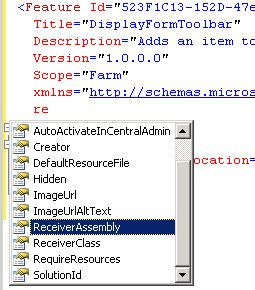
    Features are defined using XML. You can use any editor, but likely candidates include Notepad, Visual Studio, SharePoint Designer and any other XML editor. To edit XML with some form of Intellisense requires an XML schema. SharePoint supplies one named WSS.XSD and it can be found in C:\Program Files\Common Files\Microsoft Shared\web server extensions\12\TEMPLATE\XML.

    In most XML editors you can list the schema in the XML tag:
    <Feature  xmlns="http://schemas.microsoft.com/sharepoint/">
    </Feature>
    From that point on you should get syntex help from your XML editor.

    In Visual Studio you can do the above, or in the Properties panel for the XML file you can enter the path to the schema file in the Schemas property.


    <?xml version="1.0" encoding="utf-8" ?>
    <Feature Id="523F1C13-152D-47e7-8E60-7E2EB93C2EA0"
      Title="DisplayFormToolbar"
      Description="Adds an item to DisplayFormToolbar"
      Version="1.0.0.0"
      Scope="Farm"
      xmlns="http://schemas.microsoft.com/sharepoint/"
    >
      <ElementManifests>
        <ElementManifest Location="Elements.xml" />
      </ElementManifests>
    </Feature>


    <?xml version="1.0" encoding="utf-8" ?>
    <Feature Id="523F1C13-152D-47e7-8E60-7E2EB93C2EA0"
      Title="DisplayFormToolbar"
      Description="Adds an item to DisplayFormToolbar"
      Version="1.0.0.0"
      Scope="Farm"
      xmlns="http://schemas.microsoft.com/sharepoint/"
    >
      <ElementManifests>
        <ElementManifest Location="Elements.xml" />
      </ElementManifests>
    </Feature>


    image

    Note to spammers!

    Spammers, don't waste your time... all posts are moderated. If your comment includes unrelated links, is advertising, or just pure spam, it will never be seen.